
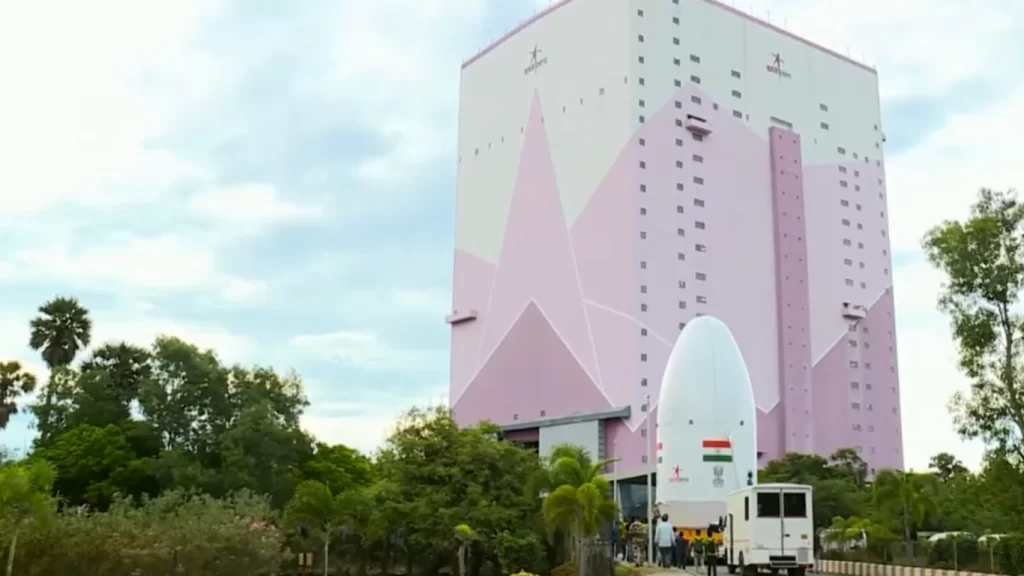
How will Chandrayaan-3 launch and land?
Gearing up for its third lunar exploration mission, India prepares to launch Chandrayaan-3 on July 14, 2023, from the Satish Dhawan Space Centre. The mission aims to land a robotic rover near the south pole of the moon. The launch will be facilitated by the Launch Vehicle Mark-3 (LVM3), a three-stage rocket.
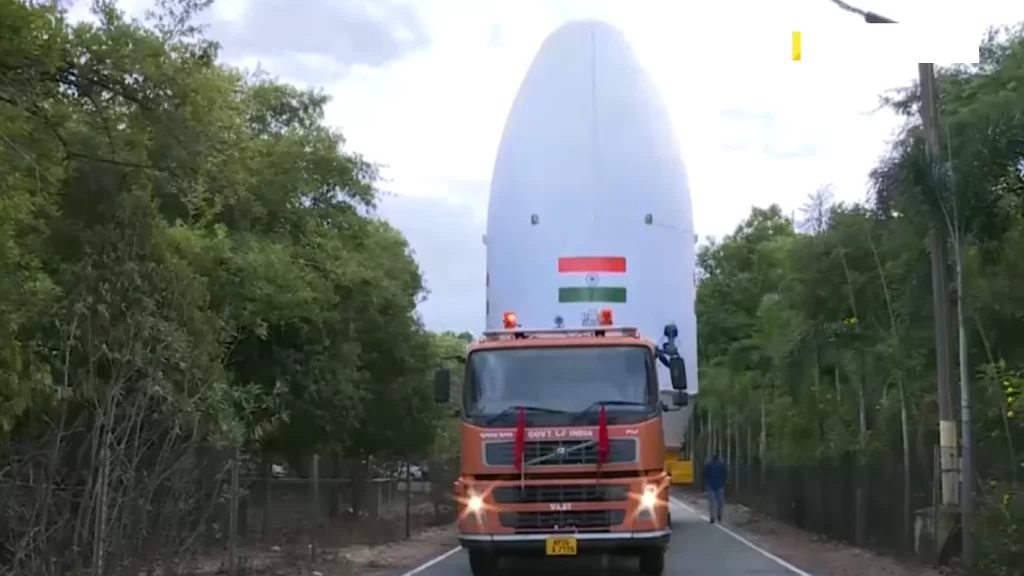
Chandrayaan-3 will launch on July 14, 2023, at 14:35 hours (local time) from the Satish Dhawan Space Centre in India. The launch vehicle will be a three-stage rocket called the Launch Vehicle Mark-3 (LVM3), which is capable of launching up to four tonnes of payload into geostationary transfer orbit or up to eight tonnes into low Earth orbit.
The LVM3 will place Chandrayaan-3 into an elliptical parking orbit of approximately 170 kilometres by 36,500 km. From there, a two-tonne propulsion module will fire its engines several times to raise its orbit and eventually reach a circular orbit at about 100 km from the moon’s surface.
The propulsion module will then separate from the lander-rover complex and remain in orbit around the moon. The lander-rover complex will then perform a series of maneuvers to reduce its speed and altitude until it reaches a point about 30 km above the lunar surface.
The lander will then initiate its powered descent phase, using its four throttleable engines to control its attitude and velocity. It will use onboard sensors and cameras to identify a suitable landing site near the south pole. It will then hover briefly before touching down softly on four legs.
After landing, the lander will deploy two solar panels to generate power and establish communication with Earth via the propulsion module. It will then unfold a ramp and release the rover onto the lunar surface. The rover will use its own solar panel and battery to power itself and communicate with Earth via the lander.
The lander and rover will operate for about 14 Earth days, which is equivalent to one lunar day. They will perform various experiments and measurements on the lunar surface, using their onboard instruments. The instruments include:
- A laser-induced breakdown spectroscopy (LIBS) instrument, which will fire a laser on lunar rocks and vaporize them to study their composition.
- A thermal probe, which will measure the temperature of the lunar soil at different depths.
- A seismometer, which will detect moonquakes and other seismic activities.
- A Langmuir probe, which will measure the plasma environment near the lunar surface.
- A radio occultation experiment, which will use radio signals to study the lunar ionosphere.
- An Earth observation payload, which will use a camera to capture images of Earth from the moon and study its atmosphere and climate.
What are the challenges and risks of Chandrayaan-3?
Chandrayaan-3 is a complex and risky mission, which involves several technical and operational challenges. Some of the major challenges and risks are:
- Launching a heavy payload into a precise orbit around the moon, which requires high accuracy and reliability of the launch vehicle and propulsion module.
- Performing a soft landing on the moon, which requires precise navigation, guidance and control of the lander, as well as avoiding hazards such as rocks, craters and slopes on the lunar surface.
- Operating in the harsh environment of the moon, which exposes the lander and rover to extreme temperatures, radiation and dust.
- Communicating with Earth via the propulsion module, which requires maintaining a stable orbit and alignment of the antennas.
- Performing scientific experiments and measurements on the lunar surface, which requires proper functioning and calibration of the instruments.
The mission also faces some external risks, such as interference from other spacecraft or debris in orbit around the moon, or geopolitical tensions that could affect international cooperation and support.
For more details information visit ISRO’s website (isro.gov.in), where you can find official updates, press releases, images, and videos of the mission.